Showing posts with label IOT. Show all posts

Monday, August 12, 2019

IoT - Wardley Maps WAR strategy


This conversation starts from Chapter 9, of WardleyMaps where it might be useful to use a map to look at the influences of predictability on a specific topic.

The next weak signal leading to predictability from Figure 106, future points of war, is what I'm looking at for Internet of Things (IOT).

I'm using a map that I've been toying with for a while.  The concept is relatively straight forward, what actions will lead to the industrialization of IoT?

We'll first start with what the map looks like for one aspect of IoT, I'm choosing data presented of some value to the user.

IOT, Wardley, Map, WardleyMap, Value, Chain, WAR
Figure 1. IoT User Visualization - Wardley Map
The second thing we should discuss is where value is derived.  Arguably, value is different to different people.  From an IoT customer's perspective, the value of the Visualization is far more visible than that of Power, Data Center or the computers it houses.

Therefore, if you're building IoT capability, the areas in the upper left are the areas you're going to want to invest in.  A simple representation of this idea on a Wardley Map looks like Figure 2.

IOT, Wardley, Map, WardleyMap, Value, Chain, WAR
Figure 2.  High, Moderate and Low Value on a Wardley Map
  The third area leads directly to pace, derived somewhat from Figure 2 and relevant because areas of attack should be at the pace required by the results.  Basically, don't lay siege to an entrenched industry, find the weak points for quick wins.

IOT, Wardley, Map, WardleyMap, Value, Chain, WAR
Figure 3.  Methods overlay on a Wardley Map
The concept is relatively simple.  Do you attack an IoT investment area in a Lean/6-Sigma area, that is already well entrenched and likely not to change rapidly, Figure 4
IOT, Wardley, Map, WardleyMap, Value, Chain, WAR
Figure 4.  Slow attack areas on a Wardley Map
 Or, do you attack an IoT investment that is in a rapidly changing area where it's using something like Agile Methods.  An area where the feedback to new method/enhancement/capability can be established in a very rapid method and is likely familiar to newer companies/organizations.  Figure 5.
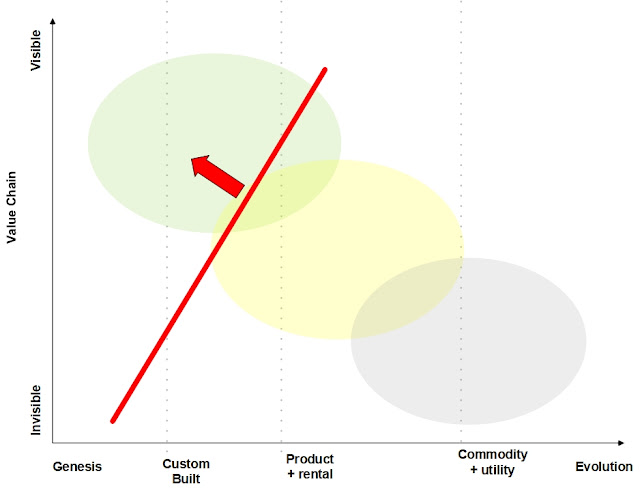
IOT, Wardley, Map, WardleyMap, Value, Chain, WAR
Figure 5.  Fast attack areas on a Wardley Map
With that perspective, the WAR over IoT will be conducted, in general, in this area.  Figure 6.

IOT, Wardley, Map, WardleyMap, Value, Chain, WAR
Figure 6.  Iot WAR on Wardley Map


Saturday, August 26, 2017

It's about the data

A friend of mine recently asked me what my thoughts were around connected home/small business.  He's kindly agreed to sharing the response.
...

In my humble opinion, it's all just verticals until something comes along to unify things and make life simpler.

It is about the Platform today.  In the future it will be about how we act on the data we have.  This will most likely shift to AI in some IoT fashion.

At the moment, I think we're are approaching a Wardly WAR stage with quite a lot of the capabilities moving from custom into product. http://blog.gardeviance.org/2015/02/on-evolution-disruption-and-pace-of.html

It's pre-industrialization of the capabilities that actually prove themselves both useful and offset either a cost, a time pressure or a labor effort that typically seem to win.

It'll almost always be about situational awareness though. A person will eventually see the thing that stands to make a serious and significant change that takes hold of one of the ecoystems and gives it a big push.

That's almost always an abstraction of the capability. I took a wild swing at one of the computing areas as an example. The abstraction of programming I called "codeless programming" that uses visual context rather than programming languages to build applications. It's the next step past "serverless" where inputs are tied to outputs by people not necessarily programming any of the intermediary application chains. http://www.abusedbits.com/2017/04/codeless-programming.html

Zuckerberg is running an experiment along these lines with his integration of capabilities using an AI.

https://www.youtube.com/watch?v=vvimBPJ3XGQ 

Thing is, getting everything to work together is ridiculously complex. Either commonality in method for integration or something that can manage the complexity is required before this is anything other than a really expensive and time consuming hobby. And then there's the data capture....

My brother has a sensor network that he literally built into his house to record a variety of data. The first dimension value of that data was to have it and be able to view it. The second dimension value of that data is to macroscopically act on it, like integrated thermostat control based on conditions and presets. The third dimension value would be to have similar information from 1500 houses and use it to design houses better, as an example.

In each one of the industries you are thinking of, the third dimension values far outweigh the two below it, but getting the data AND being able to act on it is ... difficult. The connected home products are about the only way to get at that data.

Friday, March 31, 2017

Enterprise WAN is evolving!

Enterprise WAN Reference Architecture
Figure 1.  Enterprise WAN Reference Architecture
Figure 1 represents the high level Enterprise WAN Reference Architecture that current network capabilities seem to be indicating for the support of enterprise services. 

The MPLS network will be extended and enhanced utilizing gateway functions like VPN (which we currently do), CSP access that enables direct connectivity via the MPLS network and SD-WAN that will allow the extension of the MPLS via the Internet to small and medium size locations (maybe even large locations).

SD-WAN will extend the capability of MPLS network to locations not natively available with individual carriers.  It avoids the need to NNI carriers unless it is absolutely necessary. The carriage mechanism is tunneling over the internet and can support vendor/protocol specific optimizations for some quality of service (an abstraction of the underlying IP connectivity).
     Where SD-WAN cannot be on an MPLS gateway, the internet direct to DC will be able to support this functionality.

This model also represents the dissection and reduction of networks that must be "carried twice", ingressing and egressing the Data Center perimeter security controls. These controls will eventually be migrated to the Carrier Cloud WAN Services.  They will be provisioned for specificity in the enterprise application usage model or virtualized per application within the workload execution model.
     Traffic destined for CSPs and SaaS can use a more direct path via the Internet if allowed by the Enterprise.

The CSPs, connected to the Internet, a CSP gateway to MPLS and Ecosystem networks connected directly to Data Centers will extend the Enterprise Network to support enhanced consumption of those types of services like SAS, IoT as well as the various Cloud Service Providers.

Individuals will come in over a variety of connectivity mechanisms including broadband and telco wireless.

Providing the cost structure is competitive, backup paths for many of these networks are likely to shift toward future implementations of Telco 5G.